Devices to aid repositioning in bed
This section includes equipment to help with repositioning a person in bed, either independently or via a carer. Some are designed to accommodate the size and weight of a heavier user.
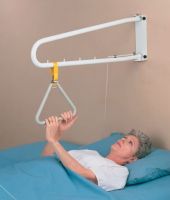
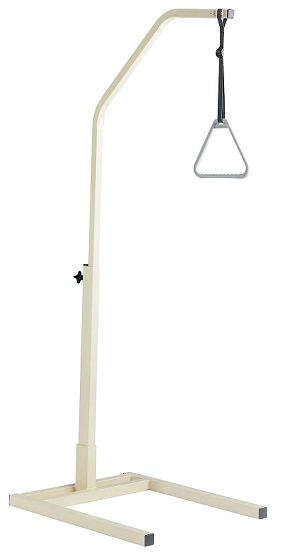
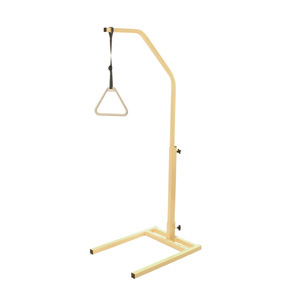
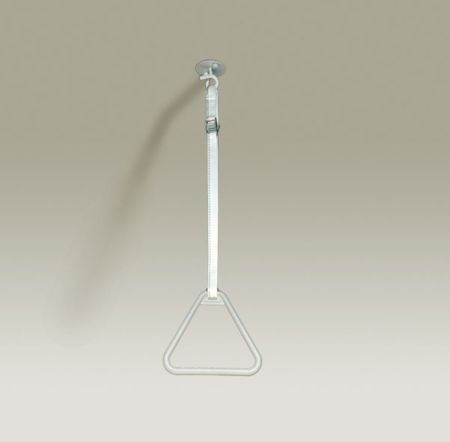
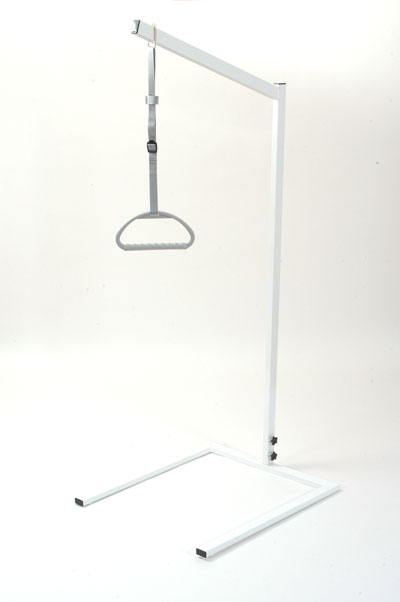
Lifting poles may be floor standing, bed attached, or wall/ceiling fixed. They have a strap hanging from them with a hand grip that is used to pull yourself into a sitting or semi-lying position. Some floor/bed poles dismantle for transporting.
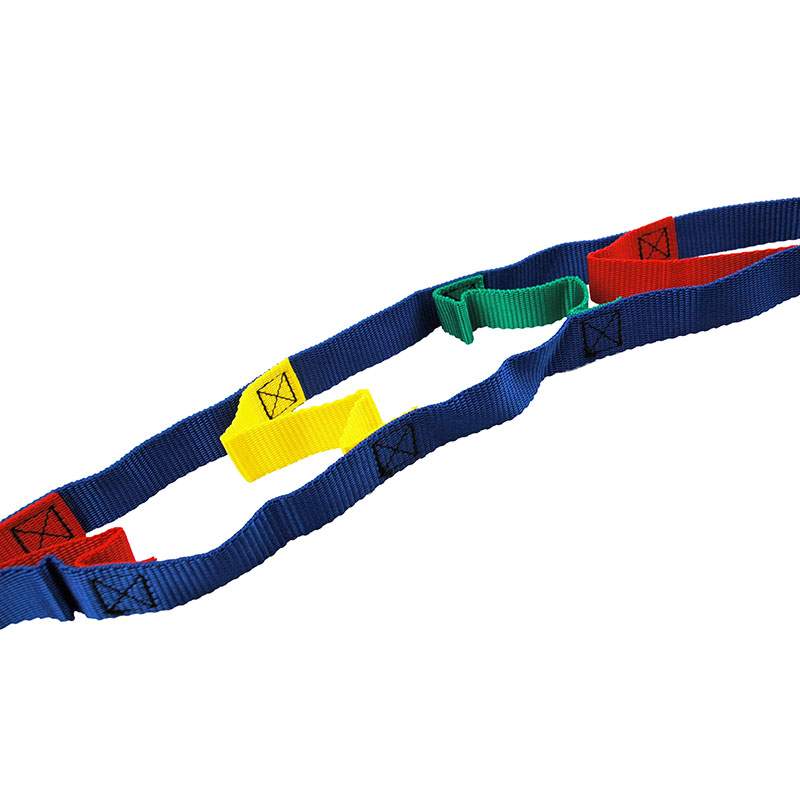
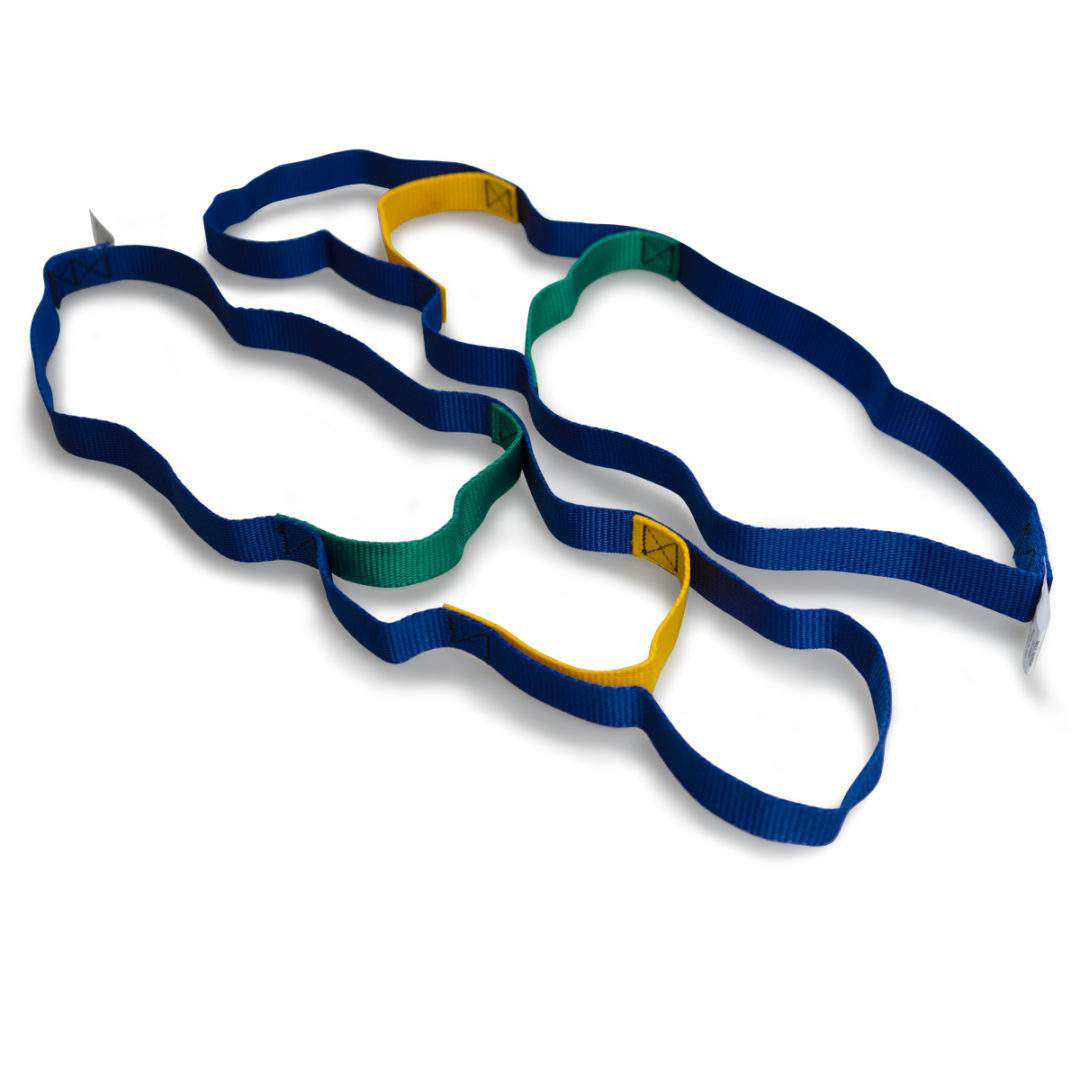
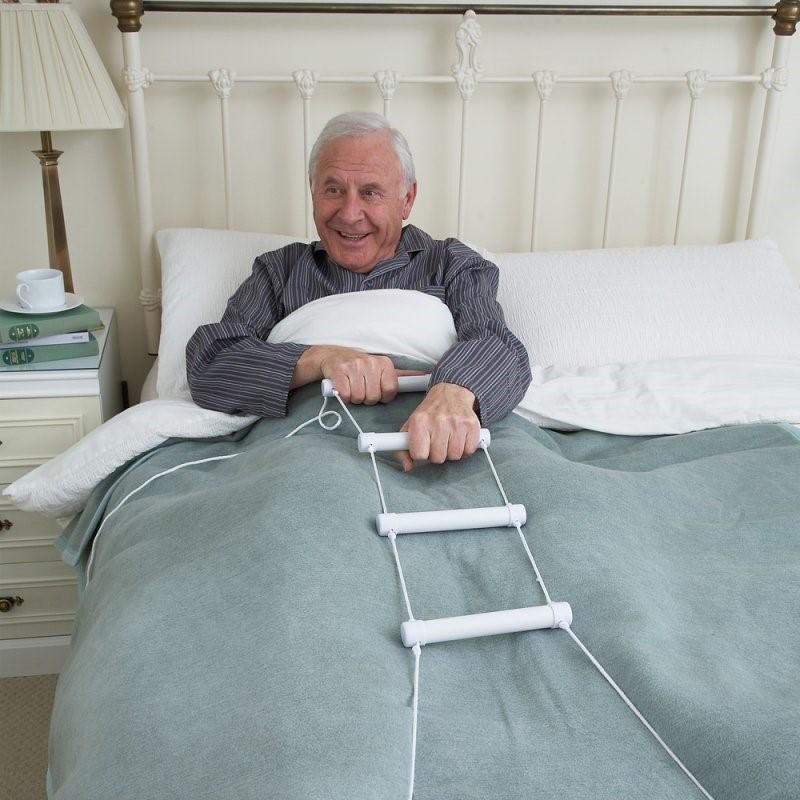
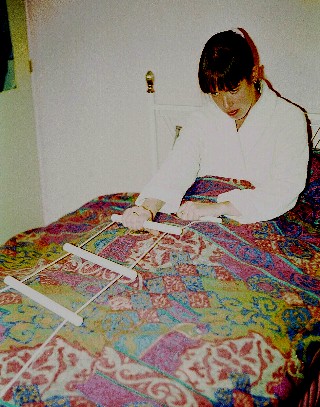
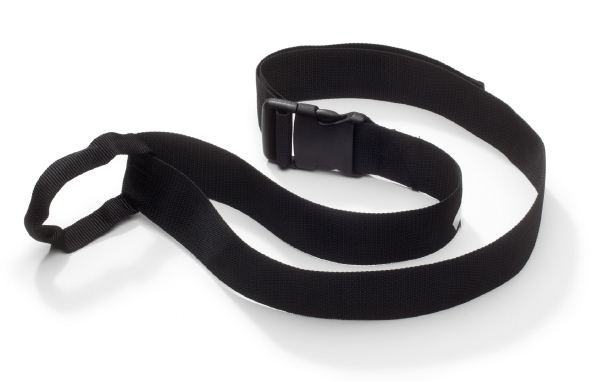
Rope ladders and pull straps are attached to the foot of the bed - either the foot board, the bed frame or the two end feet. They are lightweight and easily transported. Rope ladders have rungs which the user pulls on to help them into a sitting position. A pull strap has loops to pull on instead of rungs. Some straps have a clip that makes it easier to secure the strap to the bed.
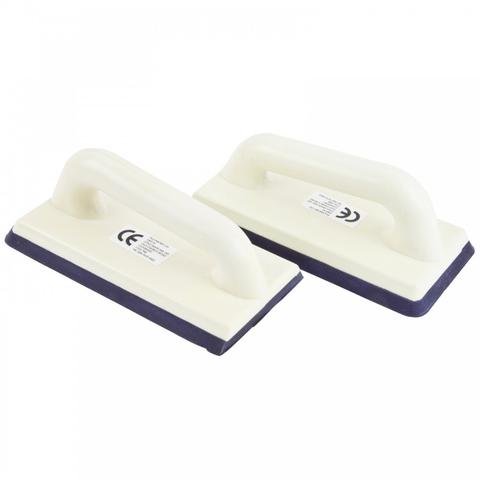
Bed blocks are placed on the bed either side of the user, and are pushed down on to raise the body up from the bed by several centimetres from the bed. This may be necessary to relieve pressure under the buttocks, to assist in moving up and down the bed, or to help in positioning a bedpan.
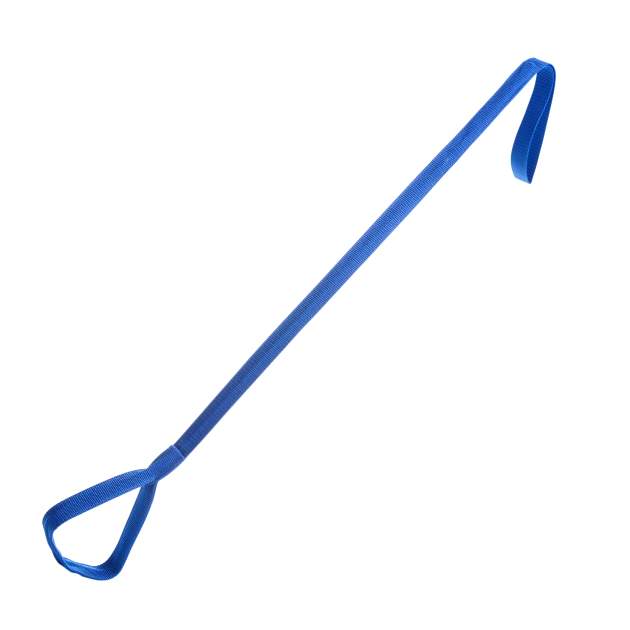
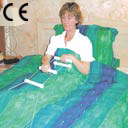
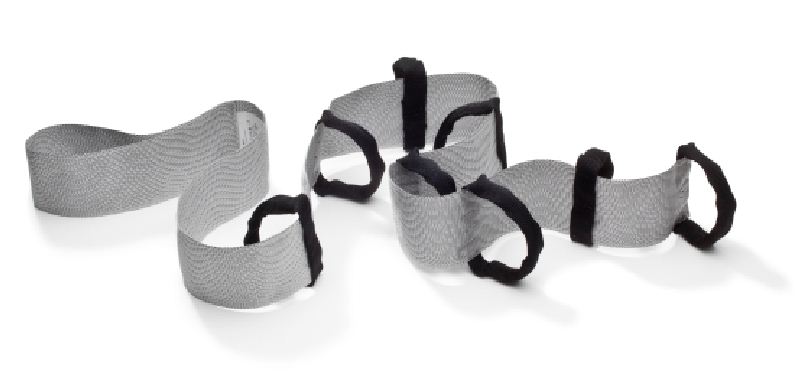
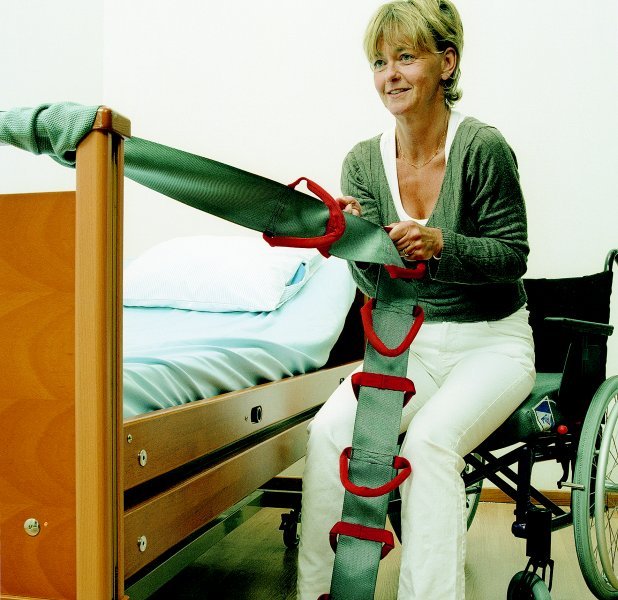
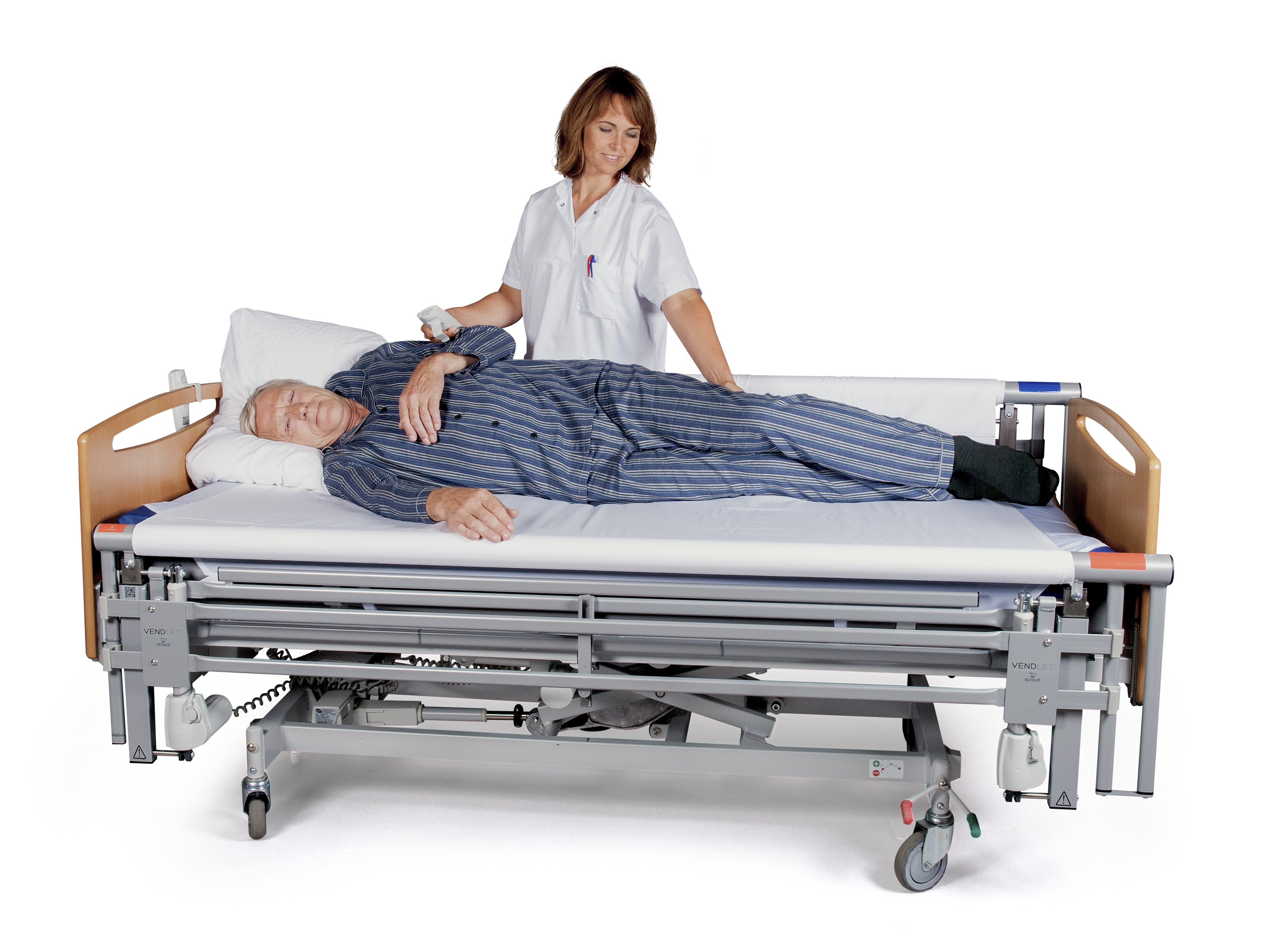
Straps that enable the user to pull themselves into a different position when in bed.
Disclaimer
This factsheet is for advice and guidance only. It is not intended to replace advice from a medical professional. Please ensure you follow manufacturer’s instructions for use and that you carry out appropriate risk assessments.
Introduction
As most people spend between a third and a half of their lives in bed, it is important to ensure that the time spent there is as comfortable as possible, and that it is easy to move around or get in or out of the bed.
For information about choosing a standard, extra-long or extra-wide bed, contact the National Bed Federation (NBF). They will be able to send you factsheets on how to choose a bed and mattress. These are provided free of charge.
The aim of this factsheet is to provide information about accessories for standard beds and beds with special features which are available to help people with specific difficulties or their carers. These difficulties may include getting in and out of bed, turning over, sitting up and generally getting comfortable in bed. Comfort and sleeping well are essential not only for the well-being of a person, but also because, for some people, they may mean the difference between being able or unable to carry out activities independently. If you are experiencing difficulty with any of the activities mentioned above, you may benefit from an assessment by a physiotherapist or occupational therapist. Sometimes a change in the way you carry out an activity or a different technique may help you to manage independently instead of using equipment.
Many of the beds with special features are available as a double bed, where one side of the bed remains as a standard bed.
British Standards
All upholstered furniture that is intended for private use in a house needs to conform to the Furniture and Furnishings (Fire)(Safety) Regulations act 1988. Within each standard there are several parts with tests of increasing severity. Check with suppliers which parts have been met.
Where to get help and advice
It is advisable to seek independent advice before buying bed accessories or buying a special bed. Sometimes another solution may help instead, or the local council or health service may provide an appropriate service. Beware of salesmen who try to persuade you to buy equipment that does not meet your needs or is poor value for money.
If you have a disability or you are caring for someone with a disability, remember that you have the right to ask social services for a community care assessment.
The council assessor considers the type and level of your need. If you have many needs, or if your needs are assessed as essential or complex, the council may help directly. For example, if you have difficulty moving in bed and getting out of bed.
If you find you would prefer a different service to the one offered by the local authority, you can ask for a direct payment of money instead. Since April 2003, this also applies to equipment the local authority may offer you.
If your needs are few or simple, the council may not help directly. For example, if your only need is that your bed is too low which makes it difficult for you to stand up, you may receive advice on alternative ways of solving the problem instead of direct help. Perhaps you may be directed to where you can buy equipment locally, visit a local independent living centre or obtain suitable mail order catalogues.
The recommendation is that before you buy any equipment, particularly beds, try it out.
Statutory provision of bed equipment
In the past, this was often seen by the different authorities as a grey area of provision. Even today, the organisation that provides this type of equipment may vary from one area of the country to another.
Sometimes it is regarded as home nursing equipment, i.e., what a community nurse considers necessary to help them carry out nursing duties effectively. Examples of items that may be supplied by a community nurse are:
- Bed backrests, bed cradles, bed tables, bed rails, bed linen.
- Beds such as pressure relief beds or mattresses and hospital-type nursing beds.
- Hoists and small handling equipment.
However, other items are regarded as daily living equipment, i.e., what enables a person to get on with daily living and may make them more independent.
This may include items such as:
- Rope ladders, bed blocks, self-lifting blocks, lifting poles, grab handles.
- Overhead and mobile hoists.
- Leg lifters.
This type of equipment may be supplied by social services.
The different authorities now have a legal duty to work together to try and ensure equipment is provided as quickly as possible after an assessment of need is agreed.
For people who need help to sit up or lie down in bed
Lifting poles
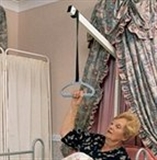
Lifting poles (or pull handles) are designed to make moving around, moving into semi-lying positions or getting in and out of bed easier. The majority have a floor standing cantilever gantry, although some are wall- or bed-attached. If freestanding, care should be taken to ensure that the base is positioned properly under the bed, otherwise the gantry frame may tip over. A handle hangs from the gantry and, when adjusted to a suitable height, some people with enough strength can pull on it safely. The user does need to have fairly strong upper limbs and good abdominal control.
Lifting poles are not usually suitable for people with painful arms, painful shoulders, limited overhead shoulder movement or abdominal weakness.
Consider the following:
- A moulded handgrip may be more comfortable to hold, and an adjustable length strap provides greater flexibility.
- Ensure that there is enough room for the base to slide under a divan bed and, where possible, fasten it to the bed headboard for greater stability.
- If the person also uses a mobile hoist for transfers, ensure that the lifting pole base does not prevent the hoist from being correctly positioned under the bed, and that the overhead arm does not obstruct the lifting boom of the hoist.
- Some models dismantle for transporting, which may make it possible to take the lifting pole on holiday.
- Remember that appearance is important, especially if the pole is to be used in a domestic setting. Some of the frames look very clinical.
Rope ladders
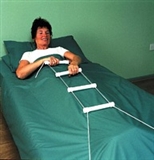
Rope ladders either fit onto the footboard, the bed frame or the two feet at the end of the bed. They have rungs which the person pulls on to help themself into a sitting position.
Ensure that the ladder is safely and securely fixed in place, and that the first rung is within reach of the person lying on the bed. Take care, as those with plastic rungs may be slippery to hold. A retrieval line pinned to the bedclothes is sometimes needed if the rope ladder slips to the floor during the night.
Pull straps
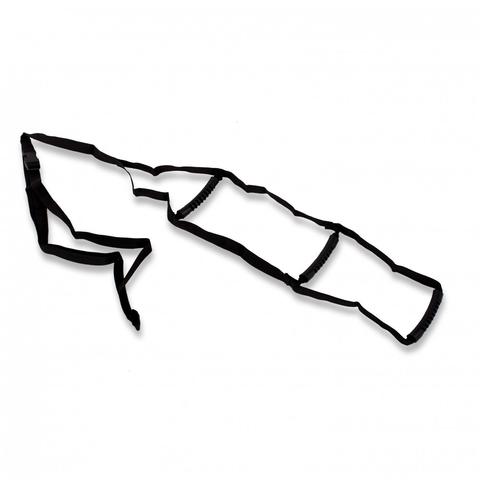
A pull strap has a similar function to a rope ladder. Instead of rungs to pull on, there are loops in the strap. Some straps have a clip that makes it easier to secure the strap to the bed. They are lightweight and easily transported.
Grab handles
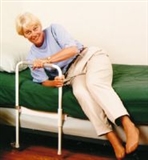
The various types of grab handles on the market are either wall-fixed, bed-fixed or floor-fixed. They are used to pull on by someone to help sit up or turn over in bed.
- Some are fixed in one position, whilst others lock into a choice of several positions. Some of the static models could obstruct part of the bedside, making it difficult to get in and out.
- Floor-fixed rails may be difficult to install if the floor is made of concrete.
- Ensure that bed-attached models are securely fixed. Some are tucked under the mattress and only rely on the weight of the person to secure them in position.
- Ensure that there is no risk of entrapment within the rail, at either end of the rail or between the rail and the mattress.
Guidance on the safe use of bed rails has been published by the Medicines and Healthcare products Regulatory Agency (MHRA).
Mattress inclinators
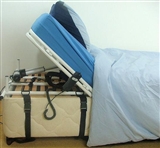
Mattress inclinators (or mattress variators) are powered devices which can help a person sit up and lie down independently. They can remain raised to form a backrest if required, and to support a person in a sitting position. They are available for single or double beds.
Consider the following:
- Check the mattress is compatible with the mattress inclinator. Hinged mattresses are most suitable and fibre- or foam-filled mattresses are usually compatible. Mattresses with continuous wire edging are unsuitable and pocket sprung mattresses may be damaged by long term use.
- Because most inclinators do not have a knee break, there is a risk the person may slip down the bed as soon as they sit up, or later after a period of sitting. Three- or four-sectioned variable posture beds have the option to raise the person's knees to help prevent this happening.
- Mattress elevators usually have a hinged frame which is placed between, and strapped to the bed base and the mattress. Depending on the model chosen, the mattress is raised by air from a powered compressor inflating an air bag enclosed in the frame, or by a hydraulic piston attached to the frame.
- The amount of noise made by these units varies. Personal preference and whether other people nearby will be disturbed needs considering. Air bags tend to be noisier, while hydraulic pistons are quieter.
- Most inclinators are controlled with a handset. Usually, this has two separate switches or one rocker switch. Alternative controls, e.g. a joystick, are sometimes available.
- Mattress inclinators and pillow lifters usually lift the person forwards and away from the bedside cabinet. A few models are designed to slide back as they lift, so that the cabinet is still in reach.
Pillow lifters
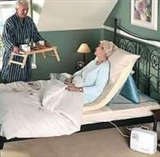
Pillow lifters (or pillow lifts) rest on the top of the mattress and under the pillow (sometimes the pillow is part of the equipment). They are similar to mattress inclinators, but are much narrower and give less support. If there is a risk that the person may fall off sideways, it is probably more appropriate to use a mattress inclinator or a variable posture bed.
Pillow lifters with a knee break reduce the risk that the person will slip down the bed.
Variable posture beds
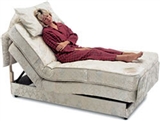
Variable posture beds have sections in the base under the mattress. The sections can hinge to form a back raise and sometimes a leg raise as well. This feature is known as profiling.
Some companies have a double bed option. Usually, this comprises of two single beds placed close together (one or both with the profiling option). If needed, ensure the beds will separate easily, e.g. for carers to assist from both sides, and/or there is sufficient clearance underneath, e.g. for the legs of a portable hoist.
Consider the following:
- Three-section variable posture beds slightly raise the user’s knees, forming a knee break that may prevent them from sliding down the bed.
- A more comfortable and stable position can be achieved in a bed with four sections, as the user’s bottom remains horizontal while the knees are raised to form a break.
- Five-section beds provide more profiling within the head/backrest section.
- Two-section beds are sit-up only. The angle of the head section is adjusted to help with sitting up/lying down or to form a backrest. There is no knee break option, and, like most mattress inclinators and pillow lifters, it is likely that the person will slip down the bed.
- Variable posture beds can be adjusted manually or electrically while the person is on the bed:
- Those with a powered mechanism are usually controlled with a handset. Although powered by a motor, most are quiet or almost silent.
- Manually operated beds are controlled by a foot-operated gas-assisted mechanism, a lever or winding mechanism or a ratchet system. The carer can find this quite hard work, and the user cannot control the adjustment.
- The mattresses for these beds are either foam, latex or sprung. They should have divisions to correspond with the sections of the bed's mattress platform. A sprung mattress with continuous wire edging should not be used, as it will make it difficult to profile the bed. It is advisable to check with the bed manufacturer if the mattress needs to be replaced at any stage. Alternatively, the National Bed Federation (NBF) can provide information on companies that sell sectioned mattresses.
- Both domestic and hospital versions of variable posture beds are available. The domestic ones tend to be smaller with a wooden or padded headboard and generally look more homely. The hospital versions are larger, usually with a metal frame, more resilient and often have a choice of nursing functions.
- It is important to check that a hospital bed provides the functions needed. Many have a tilting mechanism and most have the option of safety sides. It may be necessary to specify additional options. For example, quick release of the backrest for resuscitation, removable head and footboards for assisted transfers, or the facility to choose which bed movements the occupant is able to control.
Section mattress platforms
These can be fitted onto the frame of a standard bed so that the platform can profile the mattress like a variable posture bed. The powered mechanism is controlled by a handset.
Chair beds
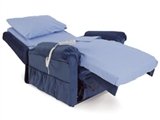
Chair beds can be used either as a bed or chair, and users do not have to transfer from chair to bed or vice versa if they need to change position or sleep.
Some take the form of very adjustable beds, which can be electrically profiled so that the person is able to achieve a sitting position. Others are primarily chairs that can be reclined fully so that the person can lie horizontally.
For people who need back support when sitting in bed
Some of the items below are occasionally used in conjunction with those in the following section - ‘For people who slide down the bed’- to prevent the person from sliding down the bed when in a seated position.
V-shaped pillows
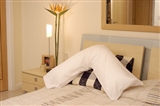
V-shaped pillows are used inverted on the bed to support the person’s shoulders, arms and neck.
Free-standing backrests
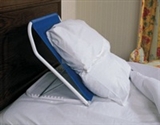
Free-standing backrests have a wooden or metal frame. The angle of the supporting surface can be adjusted for use under the pillows to support the person in a sitting position. A headboard is essential to prevent the backrest from sliding backwards. Most fold flat for storage.
Tilting headboards
Tilting headboards are pulled forward at the base to provide a backrest. They are found on many older hospital beds. The manual operation is often hazardous, involving twisting, bending and straining.
Armchair-shaped back supports
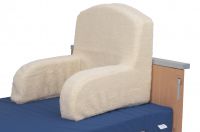
These supports are usually made of covered foam and have a backrest and armrests to provide comfort and support.
Variable posture beds
Variable posture beds can be adjusted to change the shape or profile of the bed according to the needs of the individual. The head end of the mattress can be elevated to support the back and shoulders of a person whilst they are sitting, and a knee break stops users from sliding down the bed. For further information see section ‘For people who need help to sit up or lie down in bed’.
For people who slide down the bed
The following items may help to provide a stable position for someone in bed. A person is more likely to slip down the bed when in a sitting position if they are not supported under their knees. Care should be taken that frequent sliding does not result in pressure ulcers.
Supports and wedges
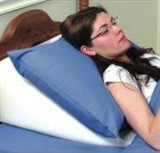
These are foam wedges or shaped pillows that can be positioned under the legs to provide support in bed.
Footboards
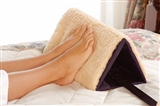
A footboard is attached to the mattress or to a fixing plate at the end of the bed. Users need to have enough strength in their legs to push against it to prevent them from sliding down the bed or to enable them to re-position themselves.
One-way glides
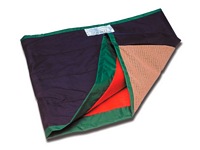
One-way glides are slip-resistant devices that move in one direction only. They are made of a length of material that has been stitched to form a continuous roller. The inside of the glide is made of a material that will easily slide one way, but cannot slide the other way. It is placed under the person sitting in bed, and enables them to slide or be slid backwards into a stable position, but not to slide forwards again. Some have foam or gel cushion inserts for comfort.
Some sliding sheets can also be used in a similar way. Care should be taken to ensure that the material does not wrinkle up under the bottom of the user, as any creases could be uncomfortable and potentially lead to pressure ulcers.
Tilting beds/Kings Fund beds
Tilting beds/Kings Fund beds are used mainly in hospitals although, on rare occasions, they are provided as nursing equipment in a domestic environment if space permits. Hospital beds are heavy and the risks of delivering and installing the bed will prohibit use in many situations. To help prevent the occupant from sliding down into either a sitting or lying position, the bed can be angled backwards by 3 or 4 degrees. Making this adjustment can be very hazardous, as the foot end of the bed needs to be lifted and lowered manually. It is preferable to use a bed with an electrically controlled tilting facility or a variable posture bed with a knee break. Some domestic-type beds have these features.
Variable posture beds
By profiling the bed into a sitting position, and by pulling on a strategically positioned grab rail or lifting pole, people may be able to take some of their body weight in order to raise themselves several centimetres from the bed. This can help them to manoeuvre their bottom to the edge of the bed from where it may be easier to stand up.
For further details on variable posture beds, grab rails and lifting poles, see section ‘For people who need help to sit up or lie down in bed’.
Mattress inclinators and pillow lifters
Mattress inclinators, or pillow lifters with a knee break that raise the person’s knees, will sometimes help to stop them from sliding down the bed when sitting up. For further information about this type of equipment, see the section ‘For people who need help to sit up or lie down in bed’.
For people who have difficulty getting their legs into bed
Manual leg lifters
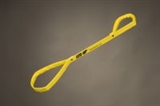
Manual leg lifters consist of a reinforced strap with a loop on the end. The person hooks their leg through the loop and then physically lifts the loop up onto the bed. However, the person concerned must have the strength, dexterity and the sitting balance to carry out the task. Some people use the crook neck of a walking stick or a looped webbing strap to perform the same task.
Powered leg lifters
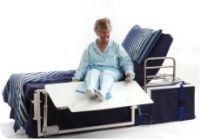
Powered leg lifters are powered devices that attach to the bed frame and require the user to sit on the edge of the bed with their feet on the floor and in front of the device. They work on the principle of a platform that raises through an arc of 90 degrees, lifting the legs of the user to a position just beyond the horizontal, level with the mattress. From this position, the user can slide their legs off the platform and onto the bed.
- Some use a compressor to fill an air sack which, as it inflates, raises the platform. However, many of these compressors make a noise like a vacuum cleaner and may be disturbing.
- Both types are controlled by a handset, which either has two separate switches or a rocker switch.
For people who have difficulty moving or turning in bed
Most people need to move or turn regularly in bed, either just for comfort or to prevent pressure ulcers from forming.
Some people may find that the use of slippery nightwear or bedding such as satin pyjamas or sheets, combined with pulling on strategically placed grab rails or handles, may help them turn over or be assisted to turn over more easily.
Variable posture beds
These can be used, with or without a pressure relief mattress, to reposition the user so that they may not have to be turned. By altering the profile of the bed, the position of the user and weight distribution will be changed. This may be sufficient to prevent pressure ulcers from forming.
If the backrest is in a semi-reclined position, the person may be able to pull on a lifting pole and roll onto one side or the other independently to relieve buttock pressure. Alternatively, this could be done by bridging, i.e. by users lifting their bottom off the bed by pushing their feet down onto the mattress with bent knees.
The height of some variable posture beds is also adjustable, either manually or electrically. Carers can raise these beds without needing to stoop and bend when assisting people to turn.
Turning beds
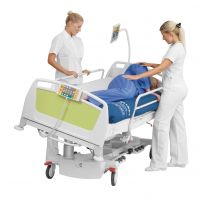
Turning beds are mains powered hospital-type beds which will turn the user from side to side. Due to their size, they are not often used in a domestic situation. Most are controlled by the carer from a panel at the end of the bed or by foot controls. Some can be controlled independently by the person in bed, while others have an automated turning facility that carries out a turning cycle. For example, every three to five minutes.
Turning units
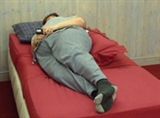
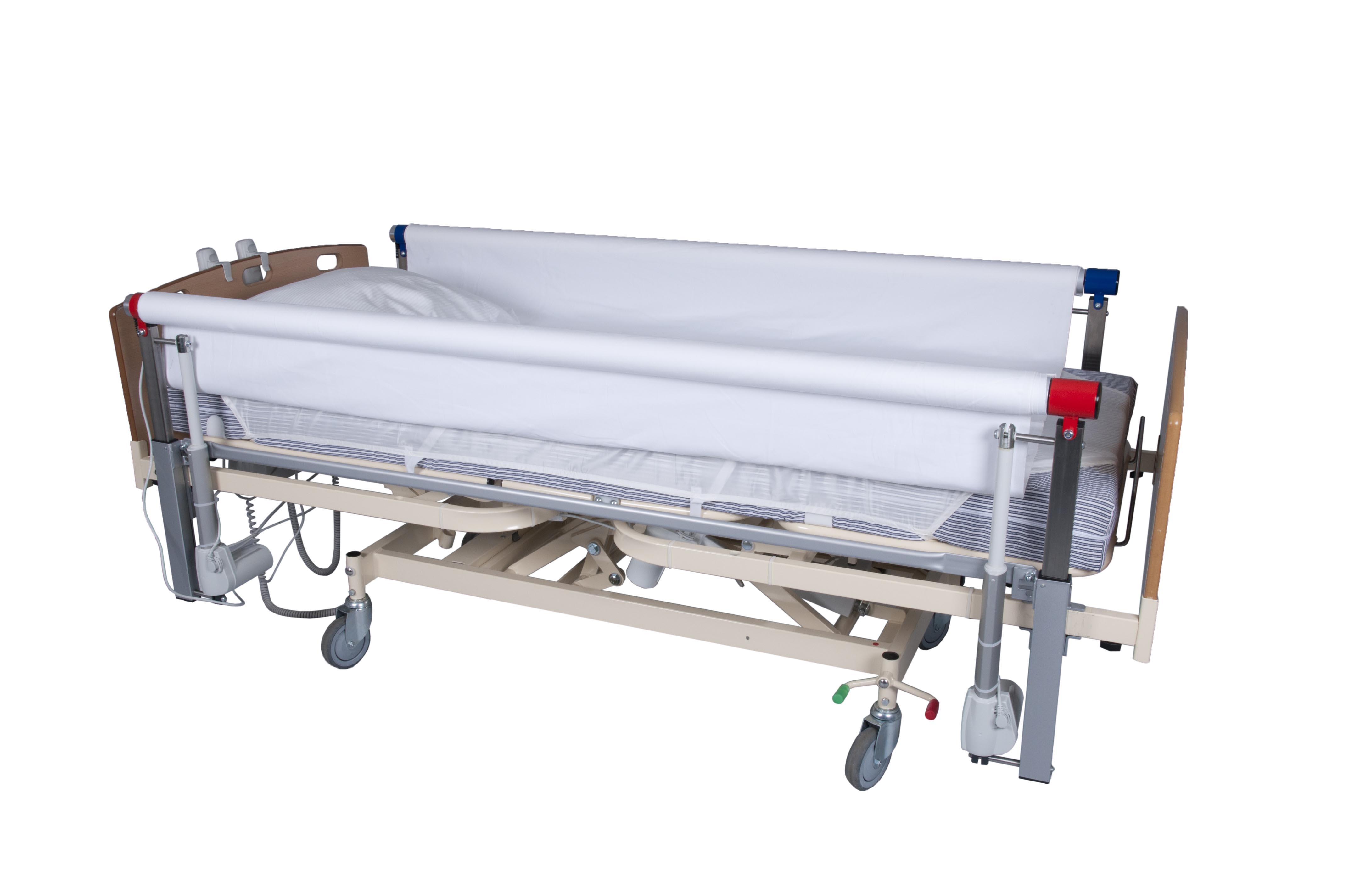
Turning units can be used on top of a domestic bed and take the form of either a sectioned mattress, which has an airbag under each side of the mattress that alternately inflates and deflates, or a turning sheet which moves around two rollers on a frame on either side of the bed. Both styles have the effect of turning the person from side to side. They can be controlled using a handset, or can be set to turn at pre-programmed times automatically.
It is advisable to use these units in conjunction with bed rails (cot sides), as they have no built-in side protection.
Low-friction rollers
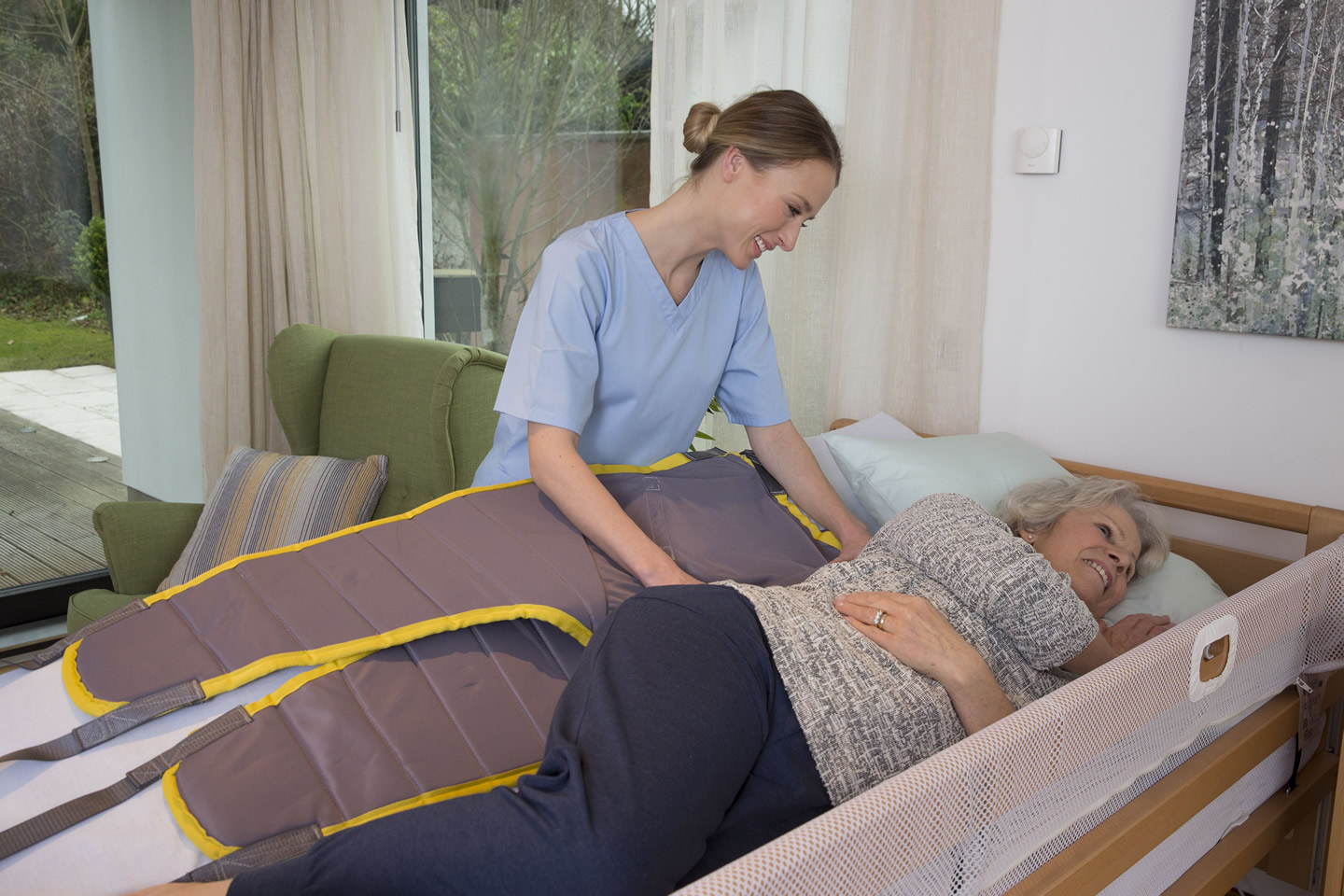
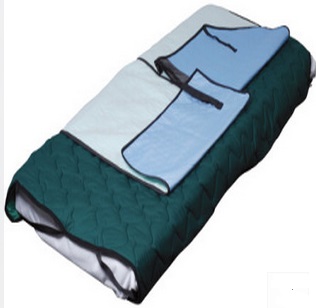
Low-friction rollers are made of a length of material which has either been stitched to form a continuous roller or is folded in a similar way so that the slippery material on the surfaces inside will easily slide against each other.
The roller is placed across the bed and under the user who is lying flat on the bed, with the open ends facing the head and feet. Once the roller is positioned, some users find they can then turn independently. Alternatively, carers can assist the user by pulling on the top layer of the roller or by pulling on a correctly positioned handling sheet on top of the roller.
Before using a product like this, carers need to know not only how to position themselves correctly, but also a safe technique, as bad posture and poor technique during these types of manoeuvres can lead to back pain or injury.
Two main sizes of roller are available: a small version (large cushion size) and a larger version (sleeping bag size). If the smaller, cushion sized roller is used, it is placed under the user’s shoulders and bottom. The larger, sleeping bag-sized version is placed so that it extends from head to toe. When used for turning, the open ends of the rollers are always towards the head and foot end of the bed.
Some rollers are padded, and can occasionally be left in position under the person. Others are very thin and are nearly always removed after use. If a roller is left in position, it is important to ensure the person will not accidentally slip out of bed.
High friction inserts are available to put in a roller to stop slipping. They are taken out when the roller is used again.
Flat sliding sheets
Sometimes two flat sliding sheets are used, one on top of another, instead of a roller. The advantage of this is that carers can use the sheets not only to assist turning, but also to move the person up the bed and across it. Sometimes the flat sliding sheets are used in conjunction with a flat board, which bridges any gap to help transfer the person from one lying surface to another.
For people who have difficulty getting out of bed
Moving to the edge of the bed
Some people find it difficult to get to the edge of the bed to swing their legs over the side. In order to move across the bed, a person must lift their bottom clear of the mattress surface. However, most people find that their arms are not long enough to do this while in a seated position. This can be the case if they are well built, or the mattress is soft and allows their hands to sink down into it. A physiotherapist or occupational therapist may advise on a specific technique to use, or alternatively, the following equipment may help.
Variable posture beds
By profiling the bed into a sitting position, and by pulling on a strategically positioned grab rail or lifting pole, people may be able to take some of their body weight in order to raise themselves several centimetres from the bed, helping them to manoeuvre their bottom to the edge of the bed from where it may be easier to stand up.
For further details on variable posture beds, grab rails and lifting poles, see section ‘For people who need help to sit up or lie down in bed’.
Bariatric beds
Bariatric beds are available if there is a need for a larger than standard size bed.
Things to consider:
- Cost: Bariatric beds can be expensive to purchase. Funding may be available (see our factsheet ‘Adapting your home: Planning and funding’) or you may like to consider a bariatric hospital bed rental.
- Environment: Is there room to deliver the bed into the room of choice? Is there adequate space around the bed for the person, their carers and any supplementary equipment required e.g. hoists?
- Mattress: A suitable mattress should be used that fits the dimensions of the bed frame (including the height of the mattress). This is important to avoid potential entrapment or falls.
- The user’s weight: This will determine the safe working load capacity of the bed to avoid accidents and enable full operation of the bed.
- The user: Their capacity to safely use the equipment, such as their ability to understand and to follow instructions.
- Other people in the house/carers: Will the bed impact on family life? Do any carers have appropriate training, such as transfers or manual handling?
More information about bariatric beds and equipment is available from the National Back Exchange.
When considering the use of non-standard equipment such as bariatric beds, it is advisable to have an assessment by an occupational therapist or other qualified health or social care professional who can carry out the necessary risk assessments and provide advice on the safe use of the equipment. Risk assessment should include (but is not limited to) moving and handling, falls prevention and the prevention of injury from the incorrect supply or use of bed accessories such as bed rails.
Hand blocks
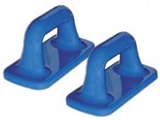
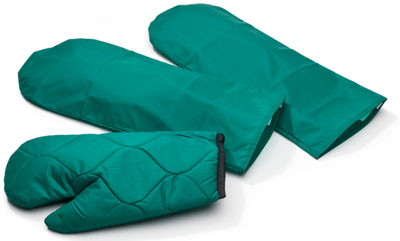
If hand blocks are placed on either side of a person, they can, by pushing down on them, raise themselves several centimetres from the bed enabling them to change their position, e.g. move towards the edge of the bed.
Ensure that the blocks have a firm base, and the handgrips are comfortable to hold.
Standing up
The major difficulty encountered by some people when getting out of bed is standing up. Raising the height of the bed sometimes helps. It is possible to buy an extra high bed, or some beds have adjustable telescopic legs which enable the bed to be set at a specific height. However, in some cases it may be difficult to find a compromise between the optimum height for the carers who are helping with personal care or nursing activities, and a suitable height for the person so that they can sit on the edge of the bed with feet firmly on the floor. Height adjustable equipment may provide a solution. This is essential if one height is needed for getting out of bed and another for getting into it.
Bed leg raisers
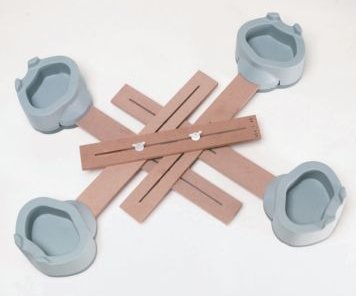
Bed leg raisers are placed under the legs to raise the height of the bed. This can make standing easier. However, once raised, the height of the bed is set, and the problems mentioned before may sometimes still be encountered. For example, although the raised height helps a person to stand, it is too high for them to sit safely on the edge of the bed and/or to lift their legs into bed.
Always ensure the bed is raised symmetrically, i.e. all the legs are raised equally. Raising one end of a domestic bed or not raising all its legs puts strain on the bed and it can collapse. Double beds can have four, six or eight legs.
Always ensure that the appropriate model of raiser is used for the bed leg, e.g. castor, square leg. The following are examples of types that are available:
- Cylindrical plastic sleeves: the bed legs stand inside the sleeves. Different depth inserts can be put inside to alter the height of the bed.
- Screw-in raisers: these screw in between the bed and the leg or castor.
- Replacement raisers: existing bed legs or castors are removed and replaced by raisers. Screw or bayonet fittings are available.
- Block raisers: cube shaped raisers with three sizes of circular recess on different sides, allowing for variation in leg size.
- Wheeled raisers: fitted with castors to allow the bed to be moved.
Elevating units
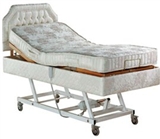
These are placed underneath a standard domestic bed to convert it into an adjustable height bed. They have a powered mechanism controlled with a handset. This has either separate push button switches or a rocker switch. Elevating units require more space than the bed, as the scissor mechanism alters the position of the bed slightly as it elevates. Care should be taken that there is no wall-mounted obstruction to prevent the bed from moving vertically or that nothing can get trapped underneath as it is lowered.
Adjustable-height beds
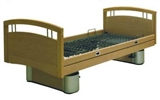
Adjustable-height beds can be powered manually or electrically. Manually operated beds usually have a hydraulic mechanism that raises and lowers the bed. This movement may feel jerky as the bed rises. The control is often a foot pump at the side of the bed. It cannot be operated by the user.
Some electric beds can be controlled by the occupant. This means that they can select the most suitable height for getting in and getting out of the bed, sometimes with little or no assistance.
- They are usually controlled with a handset, which may either have two separate switches, or a rocker switch.
- Other controls are possible, such as remote control or voice activated.
- Although powered by a motor, most are quiet or almost silent.
- Care should be taken that there is no wall-mounted obstruction to prevent the bed from moving vertically or that nothing can get trapped underneath the bed when it is lowered.
- Many adjustable height beds do not stop automatically if there is an object underneath and there is a risk of entrapment.
- Height-adjustable domestic and hospital variable posture beds are available. The domestic beds tend to be smaller with a wooden or padded headboard and are more suitable for the home environment. The hospital versions are usually larger with a metal frame and look more clinical.
For people who cannot safely take weight through their legs or whose ability to move is limited
If a person is unable to take any of their weight through their legs, advice should ALWAYS be sought from a therapist as to the safest method of assisting or moving them out of bed. Most people are not strong enough to lift someone (including many children) from the bed onto a chair/wheelchair/commode. Equipment which will do the lifting instead is available or sometimes the person may be able to slide across.
- There are mobile or overhead hoists and slings designed to lift people. Mobile hoists lift efficiently but are quite difficult to move, especially in confined spaces and across carpets. Overhead hoists lift well and have the advantage of making transferring easier. They have an overhead track which the person moves along, whilst sitting or lying in a sling.
- Sometimes small handling equipment is used to help people move in bed. Advice should be sought from a therapist on the safest handling technique and the equipment to use.
Equipment such as hand blocks or lifting poles can enable some people to lift part of their own weight whilst the carer is assisting them to move. This reduces the possibility that carers will be subjected to strain and back injury.
- Items which raise the height of the bed, e.g. bed raisers, adjustable height beds, enable a carer to assist a person at a height which reduces the risk of back injury from bending over.
- Adjustable-height beds (powered and manually operated) enable different carers to select different heights. Powered beds are easier to operate. Manually operated beds are controlled by a foot pedal or winding handle, which is situated on one or both sides of the bed. If the bed is positioned against the wall, ensure that the pedal or handle is on the accessible side. Both the pumping or winding action is quite hard work for the carer, and the bed occupant can have quite a jerky ride.
Wall-fixed/free-standing swinging hoists
Wall-fixed or free-standing hoists have a vertical mast which is either attached to the wall or fitted into a stand. A boom from the mast reaches out over the bed and swings sideways through 90 degrees, to enable a transfer from a bed onto a chair or wheelchair. The hoist has a powered lift (mains or battery), but the swinging sideways movement is manually operated. A user must be capable of pushing against the bed or pulling on a grab handle to move sideways independently.
Some of the hoisting mechanisms are portable, and can be used on wall-fixed swinging frames in different locations, either for one person or for a number of different people.
Overhead track hoists
An overhead track hoist is sometimes the best solution in a domestic situation. If the layout of the house permits, it is possible to fix a track (straight, jointed or curved) so that the person can move themself (or is assisted to move) in a sling from the bed, directly to another room in the house.
- An electric traversing system enables the user or carer to control both horizontal and the vertical movements effortlessly. Some users can manage totally independently with the appropriate handset and slings.
- A manual traversing system requires the carer to push the person along the track in the sling.
- Care must be taken because the traversing mechanism may be noisy, especially if it is fitted in a flat where other residents are living above.
- Structural alterations may need to be made such as strengthening the ceiling or adapting the top of the door frame to take the track.
- A wide range of slings is available to meet the needs of the user.
Mobile hoists
A small mobile hoist can be used for many handling tasks in and around the home. With the wide range of slings available, it can cater for many different needs and abilities.
Remember, mobile hoists are designed as lifting and transferring aids, not for transporting. If the person needs to be moved from one place to another, an overhead track hoist or specifically designed wheeled equipment should be used, as this reduces the risk of injury to the carer.
If a hoist is to be used around the bed area:
- Make sure there is sufficient space under the bed for the chassis and wheels of the hoist.
- If raisers are recommended to raise the bed for hoist access, ensure (if the increased height would make existing transfers more difficult) that they are only fitted when the hoist is available for use.
- Is there room to move the hoist away from the bed with the person sitting in the sling? It is preferable to leave enough space to pull the hoist straight back and wheel a wheelchair or sanichair in under the person. This is to avoid the carers having to turn the hoist and risk twisting their backs.
- Will the furniture need rearranging to make sufficient space to manoeuvre the hoist?
- Can the hoist be pushed easily over the floor covering? Thick pile carpet and thresholds can be difficult.
- If the height of the bed has been raised (e.g. by adding an extra mattress for pressure relief) can the hoist still lift the person so that their bottom clears the mattress surface?
- If the person falls, will the hoist reach down far enough to lift them from the floor?
- Where will the hoist be stored when not in use?
Transfer boards
Transfer boards are smooth surfaced boards, tapered at either end to assist sideways transfers. They can be used independently or with help to slide in a sitting
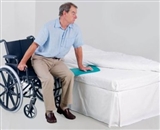
position from the chair onto a wheelchair. It is easiest if the mattress surface and the seat height are at the same level.
Curved transfer boards are useful when transferring onto chairs with fixed armrests, as they make it possible to transfer around them.
Some boards have additional transfer systems incorporated. One board has a transfer disc which moves within a central slot; another has an integral roller which the person sits on and slides across the board.
Similar transfers can be made using a low friction roller and a rigid, padded bridging device.
Turning discs
Turning discs are made up of two circular discs that rotate against one another. They are useful for someone who can semi-stand or use a board as a bridge, but finds it difficult to turn, step or adjust their feet to transfer directly from bed to chair. Users place their feet on the disc and as the transfer is made, the disc swivels.
A handling belt worn by the person can make it easier for a carer to help guide them around in a semi-standing position or across the board.
It is difficult to support someone on a turning disc. If support is needed, ask for an occupational therapist or physiotherapist to assess the situation. One possible solution is a turning disc with a frame which the person can hold onto.
Many of the solid discs use ball bearings in the swivel mechanism, which may result in fast turning that can be difficult to control. However, this may be useful when a heavier person is moving, as their weight sometimes prohibits discs without ball bearings from turning on one another.
Some discs are made of two flexible fabric discs with a slip-resistant outer surface for standing on, and a slippery inner surface. These can be used to move the feet in the same way as the solid discs, and can also be placed under the bottom of a person to help them swivel round. As they fold up, they are easier to carry around than the solid discs.
Handling belts
Handling belts are usually made from webbing, and are adjusted to fit around the waist. They usually have vertical and/or horizontal handholds to provide the carer with a firm and comfortable grip. Handling belts are used to help guide the person whilst they are standing up or sliding across a board and to help give the person more confidence. It is unsafe practice to use them as lifting belts - i.e. when a carer pulls on a handling belt to take most, or all of a person’s weight to help them to stand.
For people with continence difficulties
Waterproof bedding
All of the following are available with integral waterproof features. However, methods of waterproofing may be noisy to lie on or may cause excess sweating:
- Mattresses and mattress covers.
- Duvets.
- Duvet covers.
- Pillowcases.
Waterproof drawsheets
These narrow drawsheets are laid across the middle of the bed to reduce the risk of soiling the bed clothes. They are long enough to be tucked in on either side of the bed.
Waterproof pads
Waterproof pads are laid on the top of bedclothes, and are designed to absorb urine.
Enuresis alarms
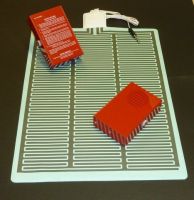
Enuresis alarms are designed to help children and adults who wet the bed to develop bladder control. Most consist of a sheet or pad with a stitched-in sensitive electrode, which is placed underneath a draw sheet. The sensor is connected to an alarm unit, which will be triggered as soon as the sensor mat detects even a few drops of urine. Audible and vibrating alarms are available.
For further information contact the Bladder & Bowel UK, a national organisation which provides information on bladder and bowel continence problems, or ERIC (Education and Resources for Improving Childhood Continence) a national charity which provides advice and information on nocturnal enuresis or bedwetting. ERIC has a telephone helpline as well as a range of bedding protection and enuresis alarms.
For people with back pain
Choosing the right bed so that the spine is properly supported can help to relieve back pain. BackCare and the National Bed Federation (NBF) produce a range of factsheets on buying a bed, with information on the different types of mattresses that are commonly available.
Bed boards
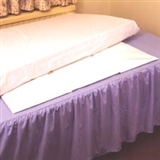
As a short-term solution, if the person's bed is too soft or sagging, a bed board can be placed under a mattress to make it firmer. However, this will only work if the bed base is soft or sprung; if the base is already solid, it will not make any difference. If a mattress has become too soft to lie on comfortably, it is usually better to buy a new mattress. It is advisable to seek advice from a physiotherapist before using a bed board.
Orthopaedic beds and mattresses
Most manufacturers of domestic beds make firm mattresses, which are often called orthopaedic although there is no national standard controlling the criteria.
The user should always try out the mattress before buying it, because what is comfortable for one person, may be very uncomfortable for another. It is advisable to visit a showroom with a range of beds and mattresses. Do not be afraid to lie on each bed and test it for as long as you can.
Companies who offer to make you an orthopaedic bed designed to suit your particular needs should be approached with caution. It may be a success, but remember that, because it is a one-off, you cannot try it out first. Companies have been known to claim, even if the bed is not comfortable, that it has been made specifically for you and that they cannot sell it to someone else.
We spend at least one third of our lives in bed. This is a lot of time to endure an uncomfortable bed.
For people who need the bed clothes away from their body or legs
Bed cradles
Bed cradles are designed to support the bedclothes at the foot end of the bed, so that a person can turn over more easily in bed and their legs and feet are protected if the weight of the bedclothes is causing undue pain or pressure. However, their presence may cause cold legs and feet.
Part of the frame runs between the mattress and the bed base so that the frame remains stable.
For people who fall or wander from bed
Bed rails (cot sides), padding and netting
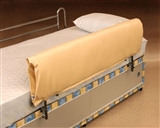
Bed grab handles are designed to aid a person getting in and out of bed and moving around whilst in bed. It is unsafe to use them as bed rails. Bed rails (cot sides) are designed to help prevent a person from rolling out of bed accidentally. It is essential that bed rails are suitable for the person who is using them and compatible with the particular beds being used. Most bed rails for domestic beds have bars which run across and between the bed and the mattress for greater security.
There is a British Standard for medical beds for children or users with a body length of up to 155cm (BS EN50637:2017 – ‘Medical electrical equipment. Particular requirements for the basic safety and essential performance of medical beds for children’).
The Medicines and Healthcare Products Regulatory Agency (MHRA) have issued a guidance on the management and safe use of bed rails which contains more details about this, including guidance on bed rail dimensions in Appendix 3.
MHRA advise that measures to mitigate the risks associated with bed rails should be considered as part of the initial risk assessment. These measures include:
- ‘Netting’ or mesh bed sides.
- Inflatable bed sides and bumpers.
- Ultra ‘low height’ beds that minimise the risk of fall injuries.
- Positional wedges to reduce movement across the bed.
- Alarm systems to alert carers that a person has moved from their normal position or wants to get out of bed.
- Fall mats that can be placed beside the bed to reduce the severity of the impact if the bed occupant does fall.
Remember:
- Bed rails should never be used to restrain a person who may attempt to climb over them. They risk falling from a greater height.
- Ensure the bed rail is suitable for the size of the occupant. Standard bed rails usually suit someone over the size of an average 12-year-old and are unsuitable for a smaller adult, young child or baby.
- Care should be taken that the person does not injure themselves on hard metal frames and that heads or limbs do not become trapped by them. Limbs, for example, can be trapped in large spaces between bars, in the gap between the end of rail and headboard, between the mattress and lowest rail of the device, or in the gap created by the weight of a patient compressing the mattress. Profiling beds need checking for dangerous gaps in all positions.
- Some bed rails are provided with net sides to reduce the risk of impact injury. Some companies supply padding to go over rails. Do not assume the netting or padding will reduce the risk of being trapped. Also, some covers are not air-permeable and may present a risk of suffocation.
- Take care if a mattress overlay is used or the mattress is changed. If the bed rail is too low (because of the extra height of the overlay) the occupant can fall over the top. Softer surfaces can increase the risk of entrapment between mattress edge and rail, and some mattresses are too light to hold the bed rail in place. There is also the risk that the rail, mattress and occupant might fall. Check whether manufacturers and suppliers can provide secure fastenings and extra height bed rails.
Standard rails have safety catches on the outside. These can prevent an otherwise independent person from getting out of bed and going to the toilet.
However, a unique model is available which serves as a safety rail, can be used independently and also helps raise the person’s legs. An air-filled platform first moves through 90 degrees to bring the platform to the horizontal, lifting their legs. The user then moves their legs across into bed. The platform can be raised a further 90 degrees to form a barrier to prevent them from falling out of bed. Pressing a button on the handset will deflate the platform to allow the user to get out of bed.
Serious injuries have occurred from the use of bed rails. The prescribing, selecting, fitting and maintenance of bed rails therefore needs considerable care. It is advisable to have a professional, such an occupational therapist, assess your needs and fit them if you are unsure about their safe use.
One solution considered to prevent accidental falls or to deter wandering, is for the person to sleep on a mattress on the floor. It is very difficult to care for a person at this level. The risks from moving and handling and the loss of independence need to be balanced against the perceived benefits.
Movement-activated alarms
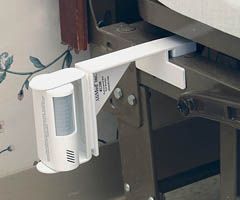
Movement monitors are available which alert a carer that a person is getting out of bed. They have a pressure sensitive plate, which is placed under the mattress and will set off an alarm when the person gets out of bed.
For people who have to lie flat for long periods of time
Reading stands
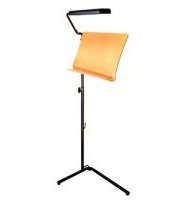
Floor-standing bookrests are available for people who are lying flat and are therefore unable to hold a book. The height of a vertical stand adjusts telescopically and a horizontal arm swivels towards and away from the user.
The book can be placed face downwards and can be angled to a convenient position for the user. On some models, the book has to be removed each time the page needs turning. It may be possible to do this independently, although some people will require help.
Page turners
A fully automated, powered device controlled by switches is available, which both holds the book in a downwards-facing position and turns the pages.
Recumbent glasses
Recumbent glasses enable a person who is lying flat or is unable to bend their neck, to read or watch television. They can be worn over normal glasses.
Mattresses for comfort
For people who display no danger signs, such as reddening of the skin, a mattress that provides comfort alone may be all that is needed.
Standard foam mattresses
This may be quite sufficient, although it should be checked every four to six months to make sure that the foam has not deteriorated.
Fibre-filled mattresses
Silicone fibre mattresses, made from hollow cored siliconised polyester fibre, feel rather like a thick duvet. Flame-retardant and washable, they can be used as a comfort mattress or for people at low risk from pressure ulcers. The resilience and softness of the mattresses may vary.
Sheepskins
Sheepskins do not relieve pressure, but can be helpful when used in conjunction with other pressure relieving support systems. This is because wool fibres are naturally resilient and help to reduce shear forces. They also help to maintain low humidity and temperature by absorbing water vapour and heat. Sheepskins come in three main forms.
Natural sheepskin
This wool fleece on its own leather backing is the most comfortable and reduces shear forces most efficiently. However, great care must be taken when washing, and the fleece must be regularly brushed so that the fibres do not become matted.
Synthetic sheepskin
These skins are less resilient than the natural sheepskin, and therefore do not reduce shear forces as efficiently. Also, they do not absorb heat and moisture so readily. However, they can be washed more easily and effectively.
Natural fleece on a fabric backing
As it has been removed from its natural backing, the pile on this sheepskin tends to be shorter than on a natural sheepskin, and is therefore slightly less resilient. However, this type of skin is easier to wash, although it still needs regular brushing to prevent matting.
For people who wish to eat or want to carry out leisure activities, such as reading in bed
Trays with a bean-filled base
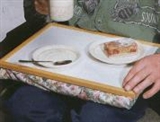
The beanbag on the underside of the tray moulds to the shape of the lap. This provides a more stable surface than a traditional tray. The trays are available with raised edges, recesses for plates and cups, and slip-resistant tray mats. They come in a choice of designs, and some have detachable beanbag bases for washing.
Trays with supports
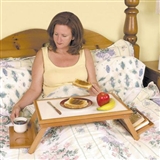
Trays with supports are high-rimmed trays with two legs and a slip-resistant tray mat. They are designed to be stabilised by the legs: the width of which can be adjusted to fit snugly on either side of the person's thighs. The legs also fold flat when not in use.
Cantilever tables
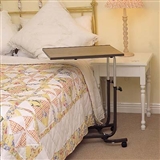
These are much smaller than bed tables and are less sturdy. The cantilever tabletop is supported on one side only, so that the table can be positioned close to the bed. Those without castors have a shallower base, and may fit under a bed with only limited space underneath, although they are more difficult to manoeuvre into position. Some have the option of a tilting top for supporting a book, newspaper, or writing paper at an angle.
Bed tables
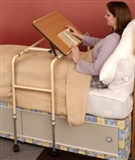
Bed tables are like hospital bed tables. They span the width of the bed with the legs resting on the floor on either side. They all have a tubular metal frame supporting a tabletop.
Book stands
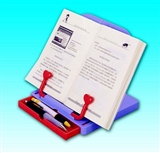
A wide range of book stands are available. Most are designed to hold books, although a few are large enough for magazines and newspapers. Some are floor standing, and their height and angle can be adjusted; others are designed to rest on a table.
Page turners
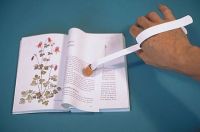
These are useful for people who are unable to turn the pages of a book. Two types of turner are available: a simple stick with a rubber tip used in the hands or mouth, or a fully automated, powered device controlled by switches, which both holds the book and turns the pages.
Storage pouches
These can be draped across the bed and provide storage pockets in which to keep bits and pieces, such as books, knitting and TV controls.
Clamping equipment
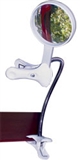
Clamping equipment provides a method for securing items such as mirrors and cups in a convenient position.
References
BackCare (2024). Available at: https://backcare.org.uk/ (Accessed: 03 December 2024).
Bladder & Bowel UK (2024). Available at: https://www.bbuk.org.uk/ (Accessed: 03 December 2024).
British Standards Institution (2017). BS EN 50637:2017. Medical electrical equipment – Particular requirements for the basic safety and essential performance of medical beds for children. Available at: https://knowledge.bsigroup.com/products/medical-electrical-equipment-particular-requirements-for-the-basic-safety-and-essential-performance-of-medical-beds-for-children (Accessed: 03 December 2024).
ERIC (2024). Available at: https://eric.org.uk/ (Accessed: 03 December 2024).
GOV.UK (1988). The Furniture and Furnishings (Fire) (Safety) Regulations 1988. Available at: https://www.legislation.gov.uk/uksi/1988/1324/contents (Accessed: 03 December 2024).
GOV.UK (2020, updated 2023). Guidance. Bed rails: management and safe use. Available at: https://www.gov.uk/guidance/bed-rails-management-and-safe-use (Accessed: 03 December 2024).
National Back Exchange (2024). Bed rails for Bariatric Equipment. Available at: https://www.nationalbackexchange.org/news/bed-rails-bariatric-equipment (Accessed: 16 December 2024).
The National Bed Federation (2024). Available at: https://www.bedfed.org.uk/ (Accessed: 03 December 2024).


 back to top